


About us
The T.SOL project is funded by the Australian Centre for International Agricultural Research (ACIAR).
It built on previous ACIAR research aimed at eliminating Taenia solium from a village in a northern province of Lao PDR. This work provided some of the first empirical evidence from South East Asia of how positive outcomes for both human and animal health can be achieved under a One health strategy survey.
This project developed five tools to detect high-risk villages for T. solium. These risk-mapping tools were validated against biological data obtained from study villages confirming the presence/absence of T. solium. The specificity and sensitivity of available diagnostic techniques were validated and basic molecular assays for Taenia spp. were trialled in one of the national laboratories. Finally, a case series was conducted in T. solium positive villages to assess behaviours associated with the transmission of T. solium which could inform the design of future interventions.
Project Objectives
Objective 1
Risk mapping tools
Develop criteria for identifying high risk villages for FBPD involving production animals in northern Laos.
Objective 2
Targeted use
Describe the unique characteristics of a T.Solium hot spot to enable targeted use of the risk factor mapping strategy
Objective 3
Burden evaluation
Assess the burden on people and production animals in high-risk villages
Objective 4
Diagnostic validation
Validate current diagnostic tests for targeted FBPD in low-middle income countries.
Objective 1
Risk mapping tools
Develop criteria for identifying high risk villages for FBPD involving production animals in northern Laos.
Risk mapping tools can help governments and other partners identify where they should focus their initial interventions and research when large scale surveys are not feasible.
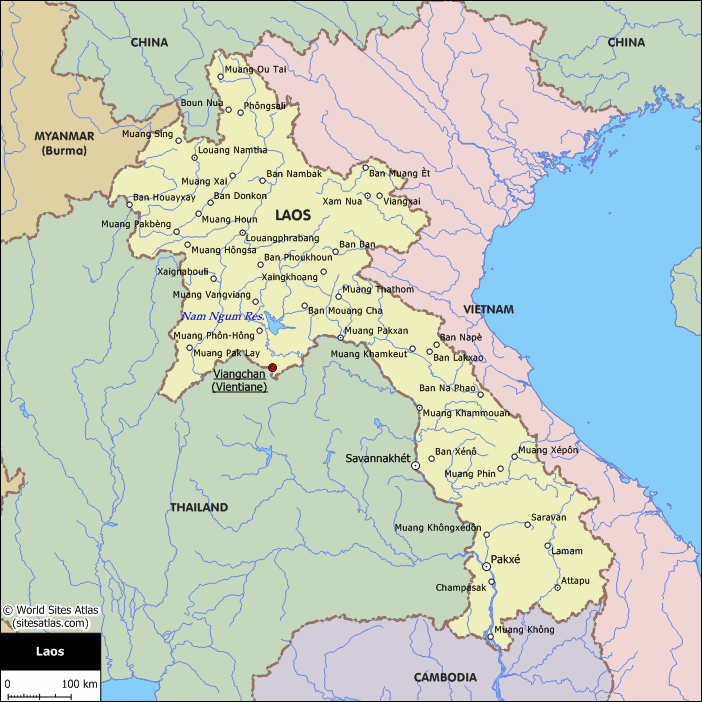
Three provinces were selected for research activities
Luang prabang
Phongsali
Oudamxai.
A preliminary risk rating of High and Low was assigned to villages within each district of each of these three provinces. From this list one high risk district was selected and 14 villages (7 high and 7 low risk rating) were randomly selected from each for further investigation. A total of 42 villages.
A rapid and an in-depth field-based risk assessment was conducted in each of the 42 villages using our project developed tool.
The tool considered 8 risk factors:
1) high levels of poverty; 2) low coverage oflatrines and the associated practice of open defecation; 3) consumption of unpotable water; 4) high levels of pig ownership; 5) the practice of free-ranging pigs; 6) consumption of raw pork; 7) cases of epilepsy as a proxy for T. solium infections; and, 8) village inaccessibility.
Application of the risk assessment tool consisted of four steps designed to explore and assess each risk factor at the village level: 1) participatory village mapping, 2) walk and talk (observations and interviews), 3) validation interview; 4) determination of risk village risk rating. In the final step, the data collected was used by the field team (rapid assessment) or qualitative researcher (in-depth assessment) to assign the final rating. The rapid assessment resulted in an overall risk rating based on the consensus of the field-team. The in-depth assessment involved systematic thematic coding of transcribed data to assess and categorise each risk factor as high or low. In-depth risk ratings for each village were established by counting the number of risk factors that were categorised as high risk. Villages with ratings of six or higher were categorised as high risk for T. solium.

OBJECTIVE 2
Targeted use
Describe the unique characteristics of a T. solium hot spot to enable targeted use of the risk factor mapping strategy and provide an understanding of the context for subsequent intervention
In addition to the data collected during the rapid risk assessments, a case series was conducted in selected villages confirmed to have T. solium positive persons. The methods employed were designed to gather specific data on behaviours associated with the sustained transmission of T. solium which could be used for future interventions. These included behaviours influencing the consumption of raw pork, behaviours of persons confirmed to be infected with T. solium, and husbandry practices associated with pig farming and parasite control.

Objective 3a
Burden evaluation
Assess the burden of FBPD on people and production animals in high-risk villages
Faecal samples were collected from a proportion of village members during rapid risk assessment activities. Information sessions were held in each village and individuals had the opportunity to return faecal samples 12–24 hours after each session.
Microscopic analysis of all samples was done at the Lao Ministry of Health using the Formol ethyl-acetate concentration technique (FECT). Random duplicates (approximately 20%) were tested by a novel modified-McMaster (McMaster2) method and Malachite green smear at Murdoch University (see Larkins et al., 2024).
Microscopy analysis was used to detect all gastrointestinal parasites with a focus on Taenia sp. and soil transmitted helminths (hookworm, Ascaris and Trichuris).
Molecular assays were used to determine species of Taenia (T. solium, T. saginata. T. asiatica) and was undertaken at Murdoch University.
Blood samples collected during an unrelated national study and stored at the Tropical Public Health Institute were used to test for the presence cysticercosis. These samples werecouriered to collaborators at the University of Ghent (Belgium) and were analysed using an antigen ELISA.

Objective 3B
Burden evaluation
Assess the burden of FBPD on people and production animals in high-risk villages
Prevalence of pig parasites
Faecal samples were collected from a proportion of pigs in villages in Viengkham and Mai districts. Microscopic analysis of all samples was done at the National University of Laos by Veterinary staff and students using the modified McMaster technique. The prevalence of gastrointestinal parasites and intensity of infection was ascertained. The results which were generated by 4th year veterinary students was used as part of their research study units.
Cascade of care for people with epilepsy
A qualitative study to examine the management of epilepsy was conducted in the three study districts (Mai, Nga and Vienghkam). The methodology employed key informant interviews, focus group discussions and participant observations with a range of people associated with epilepsy including patients with epilepsy, family/community members, biomedical practitioners and traditional healers.
Key themes investigated were the sociocultural beliefs and attitudes related to epilepsy, such as health seeking behaviours, disease burden, illness management and experiences with clinical care; biomedical and traditional medicine beliefs and practices related to epilepsy and, clinical practices, norms and barriers to diagnosis, treatment case management and quality of care. The study was conducted by a project supported TPHI master’s student and the results generated were used in their final thesis.

OBJECTIVE 4
Diagnostic validation
Validate current diagnostic techniques for targeting FBPD in LMIC
A random 20% of biological samples were selected for testing by multiple laboratory methods at both the Lao MoH and MU. The performance of different tests was compared using Bayesian latent class modelling and composite reference standards following the Standards for the Reporting of Diagnostic Accuracy Studies (Bossuyt et al., 2015; Kostoulas et al., 2017).
For diagnosing taeniasis, molecular assays using cox1 and rrnS gene regions and the formalin-ethyl acetate concentration technique (FECT), malachite smear and McMaster2 microscopy methods were compared (Larkins et al., 2024). For STHs, the FECT, malachite smear, McMaster and McMaster2 microscopy methods were compared (Larkins et al., 2024).

Useful resources
Links to our partners
ACIAR website
Murdoch University Centre for Biosecurity and One Health, Harry Butler Institute
The University of Laos https://www.nuol.edu.la/index.php/en/
Commonwealth Scientific and Industrial Research Organisation (CSIRO) https://www.csiro.au/en/
Documents
Our Team

Dr Amanda Ash
Murdoch University
Project leader

Dr Malavanh Chittavong
National University of Lao
In-Country Project leader

Dr Bounnaloth Insisiengmay
Lao Ministry of Health
Human Health Lead

Dr Davina Boyd
Murdoch University
Social Science/Ethnographical research

Dr Kevin Bardosh
Consultant
Medical Anthropologist

Dr Champathong Phochanthilath
National University of Lao
Social Science/Ethnographical research

Oula Bouphakaly
National University of Lao
Social Science and Economic Evaluation

Dr Andrew Larkins
Murdoch University
Epidemiologist

Dr Walter Okello
CSIRO
One Health Economist

Dr Mieghan Bruce
Murdoch University
Veterinary Epidemiologist

Dr Soulasack Vannamahaxay
National University of Lao
Veterinarian

Sarah Keatley
Murdoch University
Diagnostics and Field Activities Coordinator

Dr Somphou Sayasone
Tropical Public Health Institute of Lao
Diagnostic Parasitology

Assoc. Prof Fongsamouth Southammavong
National University of Lao
Animal Health

Dr Rattanaxay Phetsouvanh
Lao Ministry of Health
Human Health